Reach Subsea - Experts & Thought Leaders



Latest Reach Subsea news & announcements

Kongsberg Maritime has signed a contract with REACH Subsea ASA for the design, construction, and delivery of two additional unmanned surface vessels (USVs), expanding the pioneering REACH REMOTE fleet. The vessels will be based on Kongsberg Maritime’s UT5208 design, a purpose-built 24-metre platform engineered for remote and autonomous offshore operations. This agreement follows the success of REACH REMOTE 1 and 2, with the first vessel recently completing a series of fully remote-controlled offshore deployments off the coast of Norway. REACH REMOTE 1 was also named “Ship of the Year 2024” at the maritime exhibition SMM, highlighting its role as a trailblazer in sustainable maritime innovation. Full shipbuilding contract Kongsberg Maritime will again deliver the vessels to REACH Subsea under a full shipbuilding contract In a shift from traditional shipbuilding models, Kongsberg Maritime will again deliver the vessels to REACH Subsea under a full shipbuilding contract. Kongsberg Maritime have subcontracted the construction of the USV to a shipyard subject to Kongsberg Maritime design, supply chain management, systems integration, commissioning, and final delivery. This new way of working is particularly well-suited to projects with fleet-scale potential, offering greater efficiency, quality assurance, and speed to market. Remote and autonomous technologies Lisa Edvardsen Haugan, President of Kongsberg Maritime, said: "This contract reflects a growing industry confidence in remote and autonomous technologies.” “The success of REACH REMOTE 1 has proven that remote operations are not only viable, but they’re also transformative. By delivering these vessels, we ensure seamless integration of our advanced systems and a streamlined path to deployment. The REACH REMOTE concept is not just a technological achievement; it’s a glimpse into the future of offshore operations." Collaboration with Reach Subsea Ronny Pål Kvalsvik, VP Sales Ship Design, at Kongsberg Maritime, added: “We are proud to continue our collaboration with Reach Subsea - a repeat client for ship design and a company at the forefront of maritime innovation.” “Their pioneering work with Uncrewed Surface Vessels, such as the Reach Remote platform, exemplifies the future of sustainable and remote offshore operations. Partnering with a visionary organisation like Reach Subsea reinforces our shared commitment to safer, smarter, and more efficient marine solutions.” “This project is part of a broader industry shift toward smarter, greener, and more autonomous maritime operations. The REACH REMOTE fleet demonstrates how Norwegian innovation is transforming offshore services, reducing environmental impact while enhancing operational capability.” Ocean robotics Reach Subsea holds several exclusive options for additional vessels under the REACH REMOTE programme, supporting long-term cooperation to develop a future where ocean robotics is fully integrated into subsea operations. Jostein Alendal, CEO of REACH Subsea, added: “The Reach Remote programme is a cornerstone of our strategy to redefine subsea operations.” “By combining our subsea expertise with the naval capabilities of Kongsberg Maritime and Massterly, we are delivering real-world solutions that are safer, smarter, and more sustainable. With vessels 3 and 4 now confirmed, we are entering the scale-up phase—ready to meet global demand and shape the future of remote subsea services.” Range of integrated systems and technologies The scope of supply from Kongsberg Maritime is extensive, with a wide range of integrated systems The scope of supply from Kongsberg Maritime is extensive, with a wide range of integrated systems and technologies. This includes advanced automation and navigation systems, situation awareness solutions, manoeuvring and thruster control, low-voltage switchboards, energy storage modules, and equipment for ROV and hydrographic operations. The delivery also covers ship design and engineering, project management, and telecom systems including ship-to-shore connectivity. Joint venture Massterly, a joint venture between Kongsberg Maritime and Wilhelmsen, will manage the remote navigation and vessel operations from Remote Vessel Operations Centres. Reach Subsea will manage the subsea mission execution, including remote control of ROVs, data collection and processing. These operations are supported by a remote architecture developed by Reach Subsea in close collaboration with clients, integrating ocean robotics technologies to enable safe and efficient subsea services from shore-based control centres.
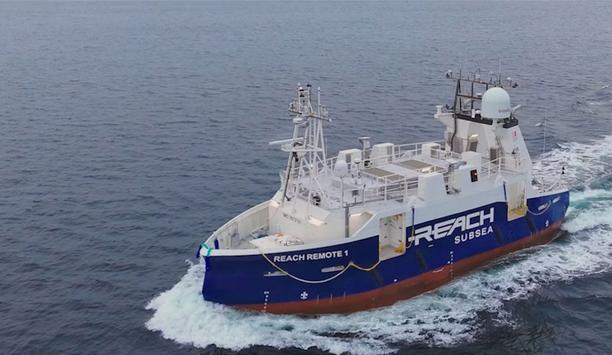
A new era of offshore operations has begun with the successful delivery of REACH REMOTE 1, a 24-metre unmanned surface vessel (USV) designed by Kongsberg Maritime. This ground-breaking achievement marks a significant milestone through collaboration between Kongsberg Maritime, REACH SUBSEA ASA, Massterly, and Trosvik Maritime. Intensive sea trials Designed to revolutionise offshore operations, the REACH REMOTE 1 is packed with cutting-edge KONGSBERG technology. Its delivery follows a programme of intensive sea trials, overseen by the classification society Det Norske Veritas (DNV) and the Norwegian Maritime Authority. Its initial mission will be to conduct underwater surveys off the coast of Haugesund, Norway, but its potential applications extend far beyond this. The second vessel, REACH REMOTE 2 is now expected to begin sea trials. Responsibility for vessel design Kongsberg Maritime served as the prime contractor for this turnkey project for vessel design Bjørg Mathisen Døving, Vice President (VP) - Reach Remote of REACH SUBSEA, said: “Reach Remote is an extraordinary journey, bringing together the unique expertise of Kongsberg Maritime, Reach Subsea, and Massterly shaping the future of uncrewed offshore operations. We are thrilled to see the Reach Remote 1 set sail and prepared for its first mission.” Kongsberg Maritime served as the prime contractor for this turnkey project, taking responsibility for vessel design, yard delivery, supply chain management, systems integration, and commissioning. The company’s deep expertise in maritime technology was instrumental in bringing this innovative concept to life. Future of offshore activities “What began as a visionary idea has now become a tangible reality,” said Lisa Edvardsen Haugan, President of Kongsberg Maritime. Lisa Edvardsen Haugan adds, “The REACH REMOTE 1USV is a testament to our commitment to pushing the boundaries of maritime technology. We are proud to have partnered with REACH SUBSEA, Massterly and Trosvik Maritime on this pioneering project. As the world transitions towards more sustainable and efficient operations, this pioneering class of vessel is poised to play a vital role in shaping the future of offshore activities.” Key feature of the REACH REMOTE USV design A key feature of the REACH REMOTE USV design is its ability to operate without a crew remotely from the ROC During the sea trials, the USV was monitored and controlled from a temporary, mobile Remote Operations Centre (ROC) located onboard a support vessel Avant, which stayed close by during several days of trials. When the USV starts pilot operations, Massterly, which is a joint venture between Kongsberg Maritime and Wilhelmsen, will control the USV from the land-based ROC in Horten, Norway. A key feature of the REACH REMOTE USV design is its ability to operate without a crew, controlled remotely from the ROC. This approach offers significant advantages in terms of operating costs, safety, and emissions, when compared to carrying out the same duties with a much larger, crewed vessel. Regulatory challenges with uncrewed vessels To ensure the highest levels of safety and reliability, Kongsberg Maritime has incorporated proven technology into the vessel's design. The company worked closely with Det Norske Veritas (DNV) and the Norwegian Maritime Authority to navigate the unique regulatory challenges associated with uncrewed vessels. Increased remote and autonomous functionality will be gradually introduced in a stepwise approach pending technology readiness.

At the SMM trade fair, DNV celebrated three advances in the ongoing development and deployment of autonomous technologies in shipping. Ocean Infinity was awarded a Statement of Compliance, while Avikus and Reach Subsea received certificates recognising their ongoing collaborations with DNV. Autonomous shipping Autonomous shipping covers many aspects of shipping’s new technological landscape – everything from systems to aid decision-making, control speed, and direction, remote controlled operation, and fully unmanned vessels. This evolution is still in its early stages, however, making close collaboration between stakeholders essential to realising the potential gains in safety, efficiency, and sustainability. Shipping efficiency and safety Knut Ørbeck-Nilssen, CEO of DNV Maritime, said, "As the maritime industry becomes more technologically advanced, DNV is committed to collaborating with industry pioneers to enhance the efficiency and safety of shipping." He adds, "In the absence of a regulatory scheme for the industry, we are developing guidelines and class notations that have been designed to evolve with the rapid advancements in autonomous technologies." Statement of Compliance Ocean Infinity’s vessel concept as the first fleet to reach the required standard of technology and operations At the SMM Trade Fair, Ocean Infinity was awarded a Statement of Compliance for its remotely supported vessel operations. Receiving this approval establishes Ocean Infinity’s vessel concept as the first fleet to reach the required standard of technology and operations for large vessels, and permits the beginning of onshoring marine-related tasks and activities. Innovation and technology Oliver Plunkett, CEO at Ocean Infinity, said, "Since we started the business, Ocean Infinity has been about innovation, technology, and pushing the boundaries in the maritime industry." He adds, "This is a significant achievement for the team. My congratulations go to them all, as well as those who have worked with them and contributed at DNV and Vard, our shipbuilder." Technology-driven progress Oliver Plunkett continues, "As we deliver our services to our customers, we are continually balancing the need for technology-driven progress with safely bringing them solutions." He further said, "Our approach is to pioneer with speed but not haste, becoming the first organisation to receive this Statement of Compliance is a testament to that. I am looking forward to watching as we begin to put our ideas of onshoring marine activities and tasks into practice." HiNAS decision support system HiNAS assists navigators by enabling ships to avoid collisions while maintaining optimal routes and speeds During day two of SMM, Avikus, HD Hyundai’s ship autonomous navigation subsidiary, and DNV celebrated the start of the test phase for the HiNAS decision support system. HiNAS assists navigators by enabling ships to avoid collisions while maintaining optimal routes and speeds. After receiving a DNV design verification report (DVR) in September 2023, the new testing phase plays an important role in the Type Approval process for the HiNAS decision support system. Autonomous navigation solutions Dohyeong Lim, CEO of Avikus, said, "We are excited to be working towards the first Type Approval for autonomous navigation solutions under DNV’s regulations, a pioneering maritime classification society." He adds, "As this is a world-first initiative, we are navigating unexpected challenges, but our close collaboration is establishing verification standards and methodologies." Maritime Autonomous Surface Ships (MASS) Dohyeong Lim continues, "This milestone is significant for both DNV, which is at the forefront of setting international standards for Maritime Autonomous Surface Ships (MASS), and Avikus, which is advancing and commercialising autonomous navigation technology." He further said, "Avikus will continue to support DNV’s efforts and collaborate across various areas to further develop and approve this technology." Reach Remote Reach is working towards a certification that will enable full autonomy in the future Another project sees Reach Subsea, working with DNV on the testing of the 'Reach Remote', their DNV-classed 24m unmanned survey vessel, which is designed to be operated remotely from its deployment. While the vessel is currently remotely operated from a mothership, Reach is working towards a certification that will enable full autonomy in the future. At SMM, the parties celebrated the ongoing cooperation and reflected on the potential of the uncrewed operations to revolutionise offshore subsea operations. Marine technology project Bjørg Mathisen Døving, Vice President at Reach Remote, said, "Reach Remote is a groundbreaking marine technology project that has demanded significant effort from everyone involved." He adds, "With no rules to steer towards, DNV's role has been valuable, also to me personally on how to navigate in a complex and uncharted environment." Additional class notation DNV has developed an additional class notation focused on autonomous and remotely operated ships (AROS), providing a framework for how auto-remote vessels can achieve equivalent or higher safety compared to conventional vessels. The notation, which is currently on hearing, applies functional requirements combined with a risk-based approach to assess the various possibilities of autonomous and remotely operated vessel concepts. DNV-CG-0264 The AROS notation is a result of many years of lessons learned by using the DNV-CG-0264 (class guidelines for autonomous and remotely operated ships) to evaluate autonomous ship concepts in collaboration with many innovative companies worldwide. DNV-CG-0264, initially launched in 2018, has also been updated to include the knowledge acquired with real-life projects. The new edition of the class guideline is also on hearing.

Fleet planning as a strategic asset
Download