Port of Amsterdam - Experts & Thought Leaders


Latest Port of Amsterdam news & announcements

A new report, released now, has found that adopting methanol as the primary fuel for voyages between the Port of Tyne, Newcastle and Port of IJmuiden, Amsterdam could avoid up to £420 million in future regulatory costs and deliver an 80% reduction in greenhouse gas (GHG) emissions. Green shipping corridors are specific routes where vessels use low-emission propulsion. The study, led by Ricardo, an environmental, energy and engineering consultancy and world pioneers in maritime decarbonisation, assessed the technical and commercial feasibility of introducing a green shipping corridor between Newcastle and Amsterdam. Alternative future fuels for vessels Looking at the potential of both methanol and onshore power supply as alternative future fuels for vessels operating between the busy ports, the study found significant reductions in emissions with the adoption of methanol, reducing GHG by 70%, and onshore power supply, reducing GHG by an additional 10-15%. Battery storage could also be adopted to support energy demand. The study also found significant financial savings, primarily through avoided regulatory penalties, which would help to offset any needed investment in new technology. Primary ferry operator The report’s findings were validated by the primary ferry operator between the ports, DFDS’ own internal analysis, which supported the economic feasibility of transitioning the Tyne- IJmuiden route to alternative fuels. DFDS plans to invest in alternative fuel-powered vessels for the corridor. Ricardo Maritime Sustainable Transport Consultant, Matt Moss, said: “Green shipping corridors represent a viable alternative to traditional carbon-heavy fuels, in an industry that is considered hard to decarbonise. The Port of Tyne – Port of IJmuiden route is not only a suitable candidate for the world’s first green shipping corridor but will also inform similar projects throughout Europe.” Net zero port operation Port of Tyne CEO, Matt Beeton, welcomed the study’s results as another important step toward establishing a North Sea green shipping corridor: "We have a vision to achieve a net zero port operation, supported by an e-fuels hub, alongside a thriving ferry route to the continent for both passengers and freight." "The transition to a cleaner future will only happen through genuine collaboration right across the maritime value chain. This report’s findings give us confidence that green shipping is within reach and that the North East can be at the forefront of the change." Green shipping corridors Zeehaven Ijmuiden N.V. - Port of IJmuiden CEO, Tjeerd van der Voorn, said: “Transforming the Tyne–IJmuiden route into one of the world’s first green shipping corridors fits seamlessly with our ambition to develop Energy Port IJmuiden." "This project has strengthened collaboration across ports, operators, engineers and public bodies, and the support of Innovate UK and the Netherlands Enterprise Agency has been instrumental. With methanol-powered vessels and onshore power, we are taking a decisive step toward a cleaner, future-ready North Sea connection.” Investing in new vessels DFDS Amsterdam-Newcastle Route Manager, Teun-Wim Leene, said: “Our ambition is to decarbonise maritime transport along the Amsterdam–Newcastle corridor. This includes investing in new vessels and collaborating with partners to accelerate infrastructure development and the production of low-emission fuels which is crucial for a successful transition.” The Port of Tyne – Port of IJmuiden study was part-funded by the UK Government's maritime decarbonisation project programme UK SHORE, which aims to reduce emissions, fuel innovation and create new jobs in the industry.
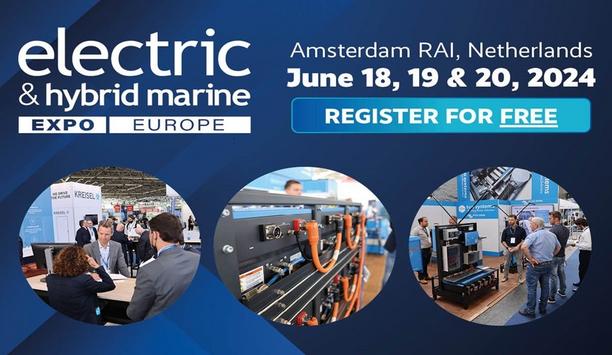
One of the world’s major exhibitions and conferences for maritime electrification, decarbonisation, and GHG reduction solutions will once again dock in Amsterdam this June. Electric & Hybrid Marine Expo Europe will feature 200+ exhibitors under one roof, PLUS a full three-day conference programme with 40+ expert speakers! Hosting industry pioneers Taking place at the Amsterdam RAI in the Netherlands, on June 18, 19 & 20, the event will host over 200 exhibitors, including industry pioneers such as ABB, Rolls-Royce Solutions, Volvo Penta, Wärtsilä, Zinus, and Speedgoat – to name just a few! Alongside the exhibition is a world-pioneering conference featuring over 40 speakers, plus a separate conference on autonomous ship technology. Global event for suppliers and engineers Throughout the event, there will be plenty of networking opportunities to meet new suppliers and reconnect This is a global event for suppliers and engineers of electric hybrid and autonomous marine systems to meet and discuss a more sustainable future and the technologies that will make it happen. Throughout the event, there will be plenty of networking opportunities to meet new suppliers and reconnect with industry peers. Fast-track the fleet’s move to more sustainable operations by attending the world’s pioneering event for marine electrification, decarbonisiation, hybridisation, future fuels, shore charging, and low-carbon shipping solutions. Propulsion solutions Entrance to the exhibition is free of charge – just visit the event website to register for an entry pass. The show is ideal for companies ranging from small regional ferry fleet operators keen to reduce costs, to international shipowners and operators wanting to learn more about tomorrow’s propulsion solutions, as well as boat builders and engine makers concerned about the latest emissions legislation. Three-day conference programme The event brings together R&D experts and engineers from across the marine sector, providing one of the best networking opportunities of the year. The three-day conference programme (for which rates apply) will bring together attendees from around the world to listen to over 40 expert maritime engineering and academic speakers from organisations including DNV, GE Power Conversion, Port of Amsterdam, Polish Register of Shipping, Rolls-Royce, the Maersk McKinney Moller Center for Zero Carbon Shipping, Wärtsilä Marine, Shell Marine, and Vard Group. Elias Boletis' presentation Unpick questions about the drivers of technological progress toward decarbonisation in the marine sector Key highlights include a presentation from Elias Boletis, chair of the CIMAC Working Group 10. The working group provides a link between shipowners and the equipment manufacturers for the marine sector, and Elias’s presentation – The challenges to ship owners in the decarbonisation process, and the responsibilities of equipment manufacturers – will unpick questions about the drivers of technological progress toward decarbonisation in the marine sector. Are they pulled along by demand from shipowners or pushed forward by equipment manufacturers? What are the implications of either approach? Which would be best and should either do more of the same, less, or something entirely different? This is a must-see presentation for any shipowner, OEM, or equipment manufacturer who wants to understand how the technology enters the market and is applied to shipping. Autonomous ship technology Another feature of the show is an area for autonomous ship technology, which has its conference programme where ship designers, classification societies, fleet owners, naval architects, research organisations, and equipment suppliers will discuss the developments needed to make autonomous operations a reality and improve efficiency. The expo will also host the revamped Electric & Hybrid Marine Awards, with a host of categories to better reflect the scale of innovation across the maritime propulsion industry. Next-gen e-outboard At the expo, Volta Future will present a revolutionary e-outboard with 222kW (300hp) continuous power and 790Nm. The next-gen e-outboard is called iWOP, which stands for invisible waterline outboard power drive. The housing of the iWOP is much more compact than classic outboard housings and contains two specially developed, high-performance electric motors together with a directly cooled double inverter. Unlike other outboards on the market, the iWOP can be mounted not only on boats with transom (outboard) but also on boats with (normally) inboards instead of the sterndrive, enabling the provision of a bathing platform instead of an engine housing. Solid-state batteries As overcharge, over-discharge, short circuits and similar issues have minimal impact other than reducing battery life EPTechnologies will showcase solid-state batteries, which the company says represent a significant advance in battery technology. Unlike traditional lithium-ion batteries, which use liquid electrolytes, solid-state batteries do not. This fundamental difference enhances safety, cycle life, and overall performance. They can be overcharged, heated to extreme values, and even punctured with a projectile with no ill effects. This opens new possibilities for applications. For instance, EPTechnologies can develop batteries equipped with a hardware override switch to bypass all electronic control systems if necessary. As overcharge, over-discharge, short circuits and similar issues have minimal impact other than reducing battery life, users can be assured of accessing the power they need, regardless of the situation. Vigilant 600 forward-looking sonar (FLS) At the Autonomous Ship Expo, Wavefront Systems will present its new Vigilant 600 forward-looking sonar (FLS). Complementing the company’s Vigilant 1000 and 1500 systems, it allows autonomous surface and subsurface vessels to transform their underwater situational information. The provision of real-time navigational and obstacle avoidance data to onboard or remotely controlled systems enables safer operations in unfamiliar or dynamic environments by dramatically reducing the risk of collisions or grounding. Patented technology capable of depth-finding at ranges ahead of the vehicle over 20 times the prevailing water depth, combined with real-time data on poorly charted seabed features and water column obstacles, enables reactive navigational autonomy.
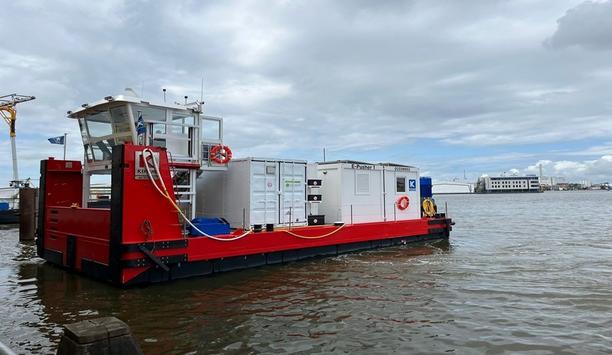
EST-Floattech is proud to announce that KOTUG International B.V., the pioneer international towage and maritime company, has chosen EST-Floattech’s containerised energy storage solution with Octopus Series for the E-Pusher 1 (Type M). On board the world’s first fully electric pusher boat is a container with the battery system of EST-Floattech, supporting the vessels every energy need. The E-pusher Type M is an innovative, emission-free pusher that transports cargo on the inland waterways, this design revolutionises the way energy is stored and distributed in the maritime industry. The E-Pusher 1 transports cocoa beans for Cargill from the Port of Amsterdam to Zaandam. Custom-built containerised solution EST-Floattech’s team has been working on the custom built containerised solution with Octopus High Energy modules. Starting out as a sparring partner to define the amount of energy needed for the propulsion and auxiliary systems, to designing the custom built containerised solution. The container has been designed and constructed in a little over half a year, thanks to the new production facilities for the Octopus Series. In those months we have been in close cooperation with KOTUG, Padmos (builder of the E-Pusher commissioned by KOTUG), Sea and Shore, and Gebhard Electro to realise the Octopus Series container which will provide reliable, emission-free power for the E-Pusher, that has been delivered to Cargill. The container is ESTRIN-Certified, testifying the to the robustness and safety of this maritime battery system. Emission-free sailing Emission-free sailing is also important for the scenic environment along the route This containerised solution provides the energy that allows the E-Pusher to make about three trips from Zaandam to Amsterdam and back. Picking up and pushing the cocoa beans to the Cargill facilities. When at the Cargill facilities in Zaandam the Octopus Series Container will be charged three times per week with green energy. Their technical engineers specifically designed the battery solution inside this container based on the sailing profile of the E-Pusher for Cargill, creatin a container with a capacity of 2MWh. This customised containerised solution and the emission-free sailing of the E-Pusher make a big difference. Starting with the people who live along the route, they no longer have noise or smell pollution. Emission-free sailing is also important for the scenic environment along the route. For the captain, it offers benefits as well: they no longer sit in the smell, there is no noise pollution from the engine, and it sails smoothly and fast. Driving positive change Ard-Jan Kooren, CEO & President KOTUG: "By selecting EST-Floattech's cutting-edge containerised battery system, KOTUG is proud to lead the maritime industry towards a greener future. The partnership with EST-Floattech signifies our commitment to innovation and sustainability. With the world's first fully electric pusher boat powered by EST-Floattech's technology, we are setting a new standard for emission-free maritime transportation. This milestone underscores KOTUG's dedication to driving positive change in the industry while delivering reliable and efficient solutions to our clients.” Walter van der Pennen, Commercial Director at EST-Floattech says: “We are proud that we have been given the chance to create this containerised energy storage system for KOTUG and contribute to the world’s first emission-free and fully electric pusher tug. We want to thank all our partners for the seamless collaboration and making this truly groundbreaking project possible.”

Fleet planning as a strategic asset
Download