NMA - Experts & Thought Leaders

Latest Norwegian Maritime Authority news & announcements

The Maritime Technologies Forum (MTF) now announced the publication of guidelines for conducting qualitative risk assessments for alternative-fuelled ships: HAZID and HAZOP. The use of alternative fuels will be key to addressing the ‘2023 IMO Strategy on Reduction of GHG Emissions from Ships.’ While IMO has developed guidelines for design and operation of ships capable of using them, the Alternative Design and Approval process is required for most alternative fuels until mandatory regulations are in place. And this dictates using qualitative risk assessment to document an equivalent level of safety compared with a vessel designed to operate with conventional fuels. Handling an alternative design Existing guidelines, such as MSC.1/Circ.1455 and IACS Rec. 146, remain valuable references to the general process for handling alternative design, independent of technology. With the industry’s expanding adoption of alternative fuels and lessons learned from recent projects, MTF considered that there is a need to make supplement to these documents to cover a wider range of fuels and technologies. HAZID and HAZOP studies The new MTF report provides guidelines for conducting qualitative risk assessments as a core component of the approval process for alternative-fuelled ships. This addresses both HAZID and HAZOP studies, detailing qualification requirements for involved personnel and outlining the procedural steps involved. The guidelines also specify required input documents, reporting requirements and risk criteria. The guidelines support the identification of potential hazardous events and the development of preventive and mitigative safeguards to manage risks associated with the use of alternative fuels. Increase in alternative fuelled vessels The new guidelines were presented at the MTF Seminar on Safe Maritime Decarbonisation held during Europort on 6 November 2025. With the expected increase in alternative fuelled vessels, both newbuilds and retrofits, panel discussions with industry pioneers focused on the relevance of the guidelines and their effective implementation to ensure consistent outcomes providing transparency and trust to the industry stakeholders. Rigorous approaches to HAZIDs and HAZOPs John McDonald, ABS President and Chief Operating Officer, said, “As the industry scales up the use of new fuels, it's essential to establish consistent and rigorous approaches to HAZIDs and HAZOPs. A unified framework is critical for maintaining safety equivalence as the industry adopts alternative fuel technologies.” Safety for novel fuel systems Alf Tore Sørheim, acting Director General, Norwegian Maritime Authority, said, “Consistency across methodologies will also help Administrations take decisions with more confidence. These guidelines are an important contribution, supporting Administrations and industry stakeholders in demonstrating safety for novel fuel systems through an alternative design process, in a more consistent and predictable manner.”

When Aker Kvaerner began work to extend the life of Equinor’s Njord A floating and drilling platform in the Norwegian North Sea to 2040, the upgrade included the replacement of the existing evacuation system with a set of modern 70-person free-fall lifeboats and a custom-designed davit system. Part way through the project, developers further updated their thinking, in a switch away from conventional diesel engines, which also brought VIKING Life-Saving Equipment its first order for E-GES-52 (Electrical Gravity Escape System) free-fall lifeboats. Electrical propulsion for lifeboats Fast forward and the Njord A installation features lifeboats that are documented to meet DNV The technology had become available after a successful three-year project between Statoil (now Equinor) and Norsafe (now part of VIKING Life-Saving Equipment) to establish a technology qualification and viability evaluation of electrical propulsion for lifeboats. Fast forward and the Njord A installation features lifeboats that are documented to meet DNV Battery Installations on vessels of less than 15 m in length – including full fire propagation testing – and SOLAS Novel Design Resolution A.520(13), as documented by the Norwegian Maritime Authority. Electric SOLAS rescue boat Confirming that the project was no one-off, VIKING has since gone on to secure an electric lifeboat project for an operator in the Western Australia offshore sector and for Aker BP’s Hugin A and Hugin B platforms – part of the Yggdrasil Norwegian Continental Shelf development 160 km west of Kollsnes, near Bergen. All-electric power is increasingly accepted as a viable solution for boat operators, with advances in battery technology also pointing toward more powerful performance from similarly sized units as power density increases. VIKING already offers the E-Mako-655 – the world’s first all-electric SOLAS rescue boat, whose 63 kWh battery pack offers four hours of continuous operations at 6 knots with a crewof three personnel. Smooth operations Battery power allows the asset owner to dispense with the need to transport, store Electric propulsion also offers operational safety benefits that lifeboat specifiers in particular will wish to consider. These include lower levels of vibration, a quieter cabin with much better air quality, increased acceleration, and higher top speeds – thereby transporting evacuees more comfortably and quickly away from the platform in an emergency when compared to diesel-powered boats. Battery power allows the asset owner to dispense with the need to transport, store, and handle diesel fuel on the platform, and avoids issues with fuel contamination altogether. Broader set of safety-based reasons A further benefit for operators working in areas affected by H2S gas clouds (sour gas environments) is that, as the battery is the entire power resource, there is no need to draw exterior air when the lifeboat is in operation. This means the boat can operate autonomously for up to two hours, compared to 10 minutes for a diesel boat. But these factors are only part of a broader set of safety-based reasons that suggest all-electric propulsion is worthy of wider consideration. VIKING’s GES free-fall lifeboats Structural part of VIKING’s GES free-fall lifeboats provides an early example of the new generation Many market watchers will know that innovations in Norway’s well-funded and safety-aware offshore industry are often adopted by others once they have proved their relevance. One basis for wider adoption is the forward-looking stance Norwegian stakeholders take with respect to safety standards and certification. In an indicative development, the structural part of VIKING’s GES free-fall lifeboats provides an early example of the new generation of designs that evolved out of the NOROG (Norske Oil and Gas -formerly OLF) industry group in 2005. VIKING Norsafe for the Njord A The most extensive study ever undertaken of conventional and free-fall lifeboat safety, this project eventually resulted in DNVGLST-E406 – the lifeboat performance standard that goes far beyond the Convention of the Safety of Life at Sea (SOLAS) and specifies no harmful accelerations in up to 100-year storm conditions. The compact, low-weight davit installations provided by VIKING Norsafe for the Njord A and for the Hugin A and B projects also merit separate attention in the safety context. Maritime regulations VIKING’s commitment to include operator preferences for simplified operations Both have been built to the NORSOK 002 standard – whose methodology includes dynamic considerations that build on crane-based safety rules, as well as being rooted in maritime regulations and VIKING’s commitment to include operator preferences for simplified operations. It is in this context that the shift to electric lifeboat propulsion should be further studied because the selection of battery power has also been made on grounds of improved reliability, reduced accident risk, easier maintenance, and through-life cost savings. Remote risks Pressure to reduce the number of personnelworking at sea or offshore is nothing new, but recent developments in connectivity, digitalization, and remote management techniques have allowed asset managers to step up efforts to automate processes, and control others from afar. Now, many offshore platforms are not normally crewed. At the same time, in being formulated for diesel engines, the maintenance procedures for lifeboats within SOLAS demand that engines are turned over for a five-minute run test every 14 days to ensure readiness for action. Specificity of the requirement The specificity of the requirement brings into focus the accident risks that maintenance engineers The specificity of the requirement brings into focus the accident risks that maintenance engineers are exposed to in landing on the platform, and when working on lifeboats in their tilted launch position. Where readiness for action is concerned, it is also understood that an engine tilted at an angle of up to 35 degrees and cold-started every two weeks will lose performance over time. It is fair to assert that the use of all-electric propulsion would mitigate risk. E-GES-45 free-fall lifeboats The E-GES-45 free-fall lifeboats, for 60 person, and E-GES-52 free-fall lifeboats are typically powered by three Akasol batteries, which are contained in robust, waterproof cases, with individual cells thermally insulated. The solution also includes a ventilation system, gas/smoke detection, and a water sprinkler system. Connected to safety The lifeboats on board Njord A have self-diagnostic programmable logic controller systems With electric systems wholly compatible with remote maintenance, equivalence also means land-based checks of operating systems are sufficient to give assurance that the boat’s propulsion system is available on arrival on board not normally crewed platforms. The lifeboats on board Njord A have self-diagnostic programmable logic controller systems, with each boat connected to an individual email address that alerts maintenance teams of any issues, or trend deviations on temperature, charge, gases, or fumes. In a real incident, the boat informed the team that attendance was needed to deal with a malfunctioning battery charger. Diesel-powered lifeboat As well as eliminating the risks brought by physically entering the lifeboat, the use of remote diagnostics, maintenance, and control methods can extend the requirement for service engineers to attend the lifeboat from once every 14 days into an annual visit. Overall, the maintenance work required to support a diesel-powered lifeboat is estimated at over 300 hours in a year. With tests of the deluge systems, steering systems, and hook release systems also remote, and the boat launch simulated, analysis indicates that the same procedures for an electric lifeboat can be accomplished in 90% less time.
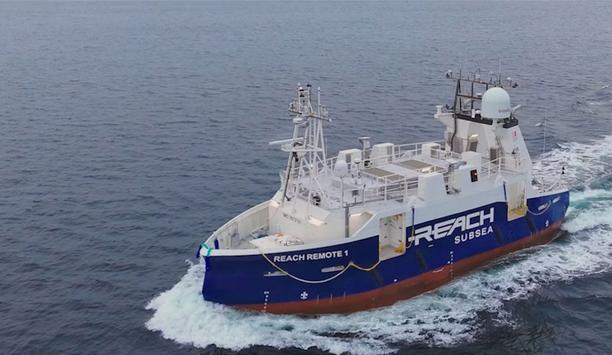
A new era of offshore operations has begun with the successful delivery of REACH REMOTE 1, a 24-metre unmanned surface vessel (USV) designed by Kongsberg Maritime. This ground-breaking achievement marks a significant milestone through collaboration between Kongsberg Maritime, REACH SUBSEA ASA, Massterly, and Trosvik Maritime. Intensive sea trials Designed to revolutionise offshore operations, the REACH REMOTE 1 is packed with cutting-edge KONGSBERG technology. Its delivery follows a programme of intensive sea trials, overseen by the classification society Det Norske Veritas (DNV) and the Norwegian Maritime Authority. Its initial mission will be to conduct underwater surveys off the coast of Haugesund, Norway, but its potential applications extend far beyond this. The second vessel, REACH REMOTE 2 is now expected to begin sea trials. Responsibility for vessel design Kongsberg Maritime served as the prime contractor for this turnkey project for vessel design Bjørg Mathisen Døving, Vice President (VP) - Reach Remote of REACH SUBSEA, said: “Reach Remote is an extraordinary journey, bringing together the unique expertise of Kongsberg Maritime, Reach Subsea, and Massterly shaping the future of uncrewed offshore operations. We are thrilled to see the Reach Remote 1 set sail and prepared for its first mission.” Kongsberg Maritime served as the prime contractor for this turnkey project, taking responsibility for vessel design, yard delivery, supply chain management, systems integration, and commissioning. The company’s deep expertise in maritime technology was instrumental in bringing this innovative concept to life. Future of offshore activities “What began as a visionary idea has now become a tangible reality,” said Lisa Edvardsen Haugan, President of Kongsberg Maritime. Lisa Edvardsen Haugan adds, “The REACH REMOTE 1USV is a testament to our commitment to pushing the boundaries of maritime technology. We are proud to have partnered with REACH SUBSEA, Massterly and Trosvik Maritime on this pioneering project. As the world transitions towards more sustainable and efficient operations, this pioneering class of vessel is poised to play a vital role in shaping the future of offshore activities.” Key feature of the REACH REMOTE USV design A key feature of the REACH REMOTE USV design is its ability to operate without a crew remotely from the ROC During the sea trials, the USV was monitored and controlled from a temporary, mobile Remote Operations Centre (ROC) located onboard a support vessel Avant, which stayed close by during several days of trials. When the USV starts pilot operations, Massterly, which is a joint venture between Kongsberg Maritime and Wilhelmsen, will control the USV from the land-based ROC in Horten, Norway. A key feature of the REACH REMOTE USV design is its ability to operate without a crew, controlled remotely from the ROC. This approach offers significant advantages in terms of operating costs, safety, and emissions, when compared to carrying out the same duties with a much larger, crewed vessel. Regulatory challenges with uncrewed vessels To ensure the highest levels of safety and reliability, Kongsberg Maritime has incorporated proven technology into the vessel's design. The company worked closely with Det Norske Veritas (DNV) and the Norwegian Maritime Authority to navigate the unique regulatory challenges associated with uncrewed vessels. Increased remote and autonomous functionality will be gradually introduced in a stepwise approach pending technology readiness.

Fleet planning as a strategic asset
Download