Equinor ASA - Experts & Thought Leaders




Latest Equinor ASA news & announcements

The first Jones Act plug-in hybrid offshore wind service operation vessel (SOV) in the United States has been christened and launched in a ceremony at the Port of New Orleans. The ABS-classed ECO Liberty was constructed by Edison Chouest Offshore (ECO) at its LaShip shipyard in Houma, Louisiana, and will be owned and operated by ECO for international energy company - Equinor. Use of hybrid systems The 262-foot vessel saw more than 500 local labourers donate to the vessel’s building, using American steel The 262-foot vessel saw more than 500 local labourers contribute to the vessel’s construction, using American steel and components from across the region. "The ECO Liberty is a milestone for both U.S. shipbuilding and the use of hybrid systems in offshore wind vessels. ABS is proud to support these growing sectors, helping clients navigate emerging technologies and evolving shipbuilding needs," said Miguel Hernandez, ABS Senior Vice President, Global Offshore. Variety of vessels Miguel Hernandez added: "ABS is committed to being a trusted partner for the growing offshore energy vessel fleet in the U.S." As the pioneering provider of classification services for the global offshore industry, ABS is in a unique position to support the variety of vessels serving the fixed and floating offshore wind market, from wind turbine installation vessels, rock installation, service operation vessels, cable laying vessels and crew transfer vessels to floating heavy lift construction vessels.
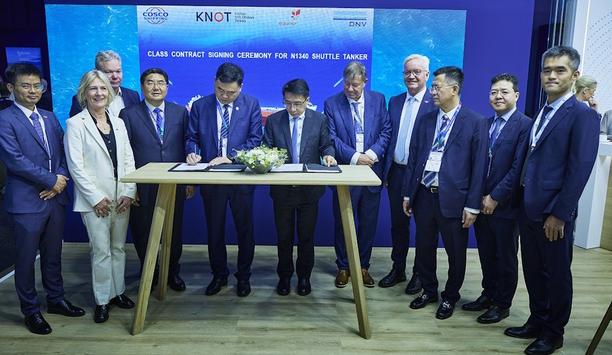
Classification society - DNV has signed a new contract with Cosco Shipping Heavy Industry Zhoushan Shipyard (COSCO) during Nor-Shipping 2025 for the classification of a newly contracted methanol-ethanol ready Suezmax DP2 shuttle tanker ordered by Knutsen NYK Offshore Tankers (KNOT). The vessel, part of a broader fleet expansion by KNOT, to be operated under charter to Norwegian energy major - Equinor, marks the latest milestone in a long-standing collaboration between the companies. Suezmax DP2 shuttle tanker The 154,000-deadweight-tonne (dwt) shuttle tanker features dual-fuel capability with methanol-readiness The 154,000-deadweight-tonne (dwt) shuttle tanker features dual-fuel capability with methanol-readiness, and complies with IMO NOx-Tier III and EEDI Phase 3 regulations. The advanced vessel design is another demonstration of how technical innovation and global partnerships are enabling the maritime industry to meet environmental requirements, and enhance sustainability and safety, while remaining efficient and competitive. KNOT, DNV, and Equinor partnership Guo Zhiqiang, Deputy General Manager, Commercial Headquarters, COSCO Shipping Heavy Industry, said: “We, COSCO Shipping Heavy Industry are pleased to see this great milestone achieved for the exciting project. We appreciate the trust and support from our partners, namely KNOT, DNV, and Equinor in the past years.” He adds, “COSCO Shipping Heavy Industry have delivered more than ten 154K DP shuttle tankers for KNOT together under the classification of DNV, and this project will be the first DP shuttle tanker we build for world first class oil major - Equinor.” Guo Zhiqiang continues, “We are proud of it and committed to implement with our high QHSE standards during the project execution and deliver a most satisfied shuttle tanker to our partners. This new milestone is a new start, and we also look forward to seeing future cooperation among the parties.” DNV and COSCO sign contract for DP2 Shuttle Tanker Tom Ketil Knutsen, General Manager Newbuiding & Innovation at KNOT, said: “We are proud to attend the signing of a new contract between DNV and COSCO SHIPPING Heavy Industry (Zhoushan) Co., Ltd, for a 154.000 dwt DP2 Shuttle Tanker, set for delivery in early 2028.” Tom Ketil Knutsen adds, “Knutsen NYK Offshore Tankers are thrilled to mark this as another exciting chapter in the enduring relationship between DNV, Equinor and Knutsen - a partnership rooted in mutual trust and collaboration from our early beginning in the North Sea to our expansion into the Brazilian waters. This milestone not only strengthens our bond but also celebrates the continued success of our collaboration.” Support the expansion of KNOT’s shuttle tanker fleet Øyvind Pettersen, Head of the Technical Centre China at DNV Maritime, commented: “At DNV we are very pleased with the trust placed in us as the classification partner for this exciting new project, and to support the continued expansion of KNOT’s shuttle tanker fleet. Each COSCO newbuilding reflects a shared commitment from all partners to safer, lower-carbon, more efficient, and technically advanced offshore operations.” Øyvind Pettersen adds, “We are committed to providing the independent assurance and technical standards that are helping to bring greater transparency and trust to these investments and look forward to continuing this productive cooperation. In addition, DNV extend our heartfelt congratulations to KNOT as they celebrate their 40th anniversary, made even more special by marking it here at Nor-Shipping.” Vessel to be equipped with McGregor's bow loading system The vessel will be equipped with a fifth-generation bow loading system developed by McGregor, to enhance the safety and efficiency of loading from offshore production units in challenging sea conditions. In addition, it will be shore power ready and fitted with VOC prevention systems to reduce operational emissions. This is the sixth vessel in a current series of newbuilds placed by KNOT at COSCO, bringing the total number of DP2 Suezmax shuttle tankers ordered by KNOT at the yard to 12 vessels.

Technology group - Wärtsilä has signed a contract with Norwegian shipowner - Eidesvik to supply the equipment for the conversion of an offshore platform supply vessel (PSV) to operate with ammonia fuel. The vessel, ‘Viking Energy’, which is on contract to energy major - Equinor, is scheduled for conversion in early 2026 and is expected to start operating on ammonia in the first half of 2026, becoming the world’s first ammonia-fuelled in-service ship. In addition to chartering the vessel, Equinor contributes with financing for the conversion. Wärtsilä will then supply the engine and complete fuel gas supply system and exhaust after-treatment needed for the conversion, making it also the first vessel to use Wärtsilä’s recently released ammonia solution. New global regulations Ammonia will play a significant role in enabling the shipping industry to reduce its emissions Ammonia has emerged as a promising alternative fuel as the shipping industry looks for more sustainable fuel options. With new global regulations having set a clear destination for shipping – net zero emissions by mid-century – ammonia will play a significant role in enabling the shipping industry to reduce its emissions. A recent report by Wärtsilä highlights the role that sustainable fuels will play in achieving this target, which is set by the International Maritime Organisation (IMO). According to the report, existing decarbonisation solutions, such as fuel efficiency measures, can cut shipping emissions by up to 27 percent; however, sustainable fuels, such as ammonia, will be a critical step in eliminating the remaining 73 percent. New generation of sustainable fuels In this context, Håkan Agnevall, President and CEO of Wärtsilä highlights the importance of cross-industry collaboration, said: "In just 25 years – the lifetime of a single vessel – shipping needs to get to net zero emissions. Achieving this will require coordinated action by all maritime industry stakeholders to bring about the system change needed to accept a new generation of sustainable fuels." He adds, "With this new contract, together with Eidesvik, Wärtsilä is proud to be at the forefront of this movement. Decarbonisation is front and centre of our strategy and we are committed to developing and delivering sustainable solutions which not only ensure the viability of sustainable fuels, but also their safety." Wärtsilä dual-fuel engine technology The conversion of Viking Energy is the latest project in the history of the union between three companies Wärtsilä, Eidesvik and Equinor share a commitment to support the industry’s efforts to decarbonise. The conversion of Viking Energy is the latest project in a history of collaboration between the three companies. Viking Energy has an impressive record of demonstrating new environmental technologies, which includes three 'world records'. For example, using Wärtsilä dual-fuel engine technology, Eidesvik was the world’s first shipowner to have an LNG-powered offshore platform supply vessel. It also received the world’s first Battery Power notation, given to Viking Energy, for a battery system installed by Wärtsilä. Research and innovative solutions This latest partnership is a result of the ‘Apollo’ project, which is co-funded by the Horizon Europe framework programme. The programme aims to accelerate the transition towards a climate-neutral Europe by 2050 through funding projects, such as Apollo, which contribute research and innovative solutions in various sectors related to climate, energy and mobility. "Close collaboration throughout the value chain is key to succeed in the green transition. Eidesvik has a unique history of pioneering the implementation of innovative emission-reducing technologies, and we are proud to spearhead yet another ground-breaking project together with Wärtsilä and Equinor," said Gitte Gard Talmo, CEO & President of Eidesvik Offshore. Wärtsilä 25 Ammonia engine In addition to the Wärtsilä 25 Ammonia engine, Wärtsilä will supply the complete ammonia solution, including its AmmoniaPac Fuel Gas Supply System, the Wärtsilä Ammonia Release Mitigation System (WARMS), and a selective catalytic reduction (SCR) system designed for ammonia. A service agreement, covering maintenance, is a highly essential part of the deal. The conversion project is planned for early 2026, with final commissioning expected in Q2 2026.

Fleet planning as a strategic asset
Download