Cargill Ocean Transportation - Experts & Thought Leaders



Latest Cargill Ocean Transportation news & announcements

Anemoi Marine Technologies, a pioneer in wind-assisted propulsion technology, has developed an in-service performance verification process that reduces cost and complexity for operators while improving accuracy compared to existing practices. The new methodology aims to enable greater uptake of the climate-neutral, energy-saving advantages of wind-assisted propulsion. Wind-assisted propulsion system The data is used to calibrate predictions on forces generated by the rotor sail system The process, validated by the class society Lloyd’s Register Advisory, involves measuring vessel data when the wind-assisted propulsion system is turned on and off while encountering various conditions during regular operation. The data is used to calibrate predictions on forces generated by the rotor sail system and their impact on the vessel, which can be used to predict voyage fuel savings with high levels of confidence. Performance assessment methodology Anemoi Technical Director, Luke McEwen, said: “With this paper, our aim is to bring greater transparency and consistency to the evaluation of wind-assisted propulsion systems." "By describing our performance assessment methodology in detail, we hope to contribute meaningfully to the wider industry discussion and move closer to a standardised framework that enables clear, comparable results across all WAPS technologies." "While various approaches exist, a unified standard will be key to supporting informed decision-making and accelerating decarbonisation in shipping.” Challenges of applying traditional methodologies Lloyd’s Register Advisory confirmed that these benefits are accrued while improving the accuracy The methodology - published in the new whitepaper, Performance Verification Of Wind-Assisted Ship Propulsion Systems By On-Off Testing - can be used for all wind-assisted propulsion solutions, not just Anemoi’s Rotor Sails. It overcomes the challenges of applying traditional methodologies, such as ISO 19030, to WAPS assessment and eliminates costly operational changes, such as taking vessels off hire to perform dedicated WAPS sea trials, which are proposed by some standards. Lloyd’s Register Advisory confirmed that these benefits are accrued while improving the accuracy of overall fuel saving predictions. Standards around wind-assisted propulsion verification Lloyd’s Register Advisory Ship Performance Manager, Dr. Santiago Suarez de la Fuente, added: “The current standards and guidelines around wind-assisted propulsion verification are relatively sparse, and an opportunity exists for a process that is robust, widely adopted, and transparent." "Anemoi’s methodology achieves this, allowing for predictions of performance to be applied to the entire range of conditions that a vessel and the system will encounter, without tests needing to be conducted in every condition.” Average net propulsion fuel savings Anemoi’s process can be used throughout the life of the vessel to generate accurate fuel savings The model developed using Anemoi’s process can be used throughout the life of the vessel to generate accurate fuel savings values, either in real time or on a voyage-by-voyage basis. It also enables the creation of advanced predictive tools that can estimate the power and fuel savings of WAPS-equipped vessels in a wide range of conditions. Anemoi and Lloyd’s Register Advisory recently announced the results of the TR Lady Kamsarmax, equipped with three of Anemoi’s 5m diameter, 24m tall Rotor Sails, assessed using the methodology outlined in the paper. Following a year-long, multi-voyage testing period, the robust approach demonstrated average net propulsion fuel savings of 9.1% and 7 tonnes of CO2e per sailing day. Digital twins for TR Lady Commenting on the TR Lady’s performance testing, Chris Hughes, Decarbonisation Specialist at Cargill, the vessel’s charterer, said: “Building up an accurate understanding of the real-world, on-ship performance of technologies is a key piece in the wind assist propulsion puzzle." "By combining the data from more than 167 rotor on/off tests that were conducted by the TR Lady, together with the independent verification from LR, Anemoi instilled confidence in the accuracy of their analysis." "We have already used the results of this study to fine-tune our weather routing digital twins for TR Lady, and it will also help inform future decisions on deploying wind assist across our fleet.”
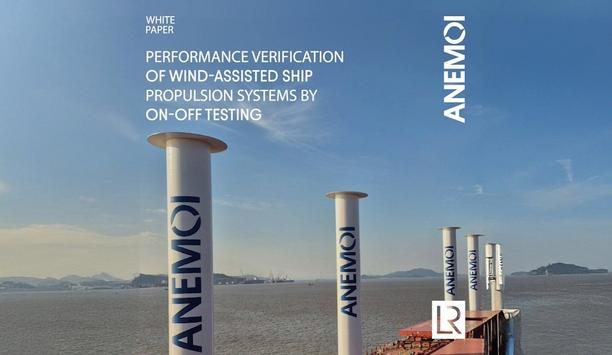
Anemoi Marine Technologies, a pioneer in wind-assisted propulsion technology, has developed an in-service performance verification process that reduces cost and complexity for operators while improving accuracy compared to existing practices. The new methodology aims to enable greater uptake of the climate-neutral, energy-saving advantages of wind-assisted propulsion. Rotor sail system The data is used to calibrate predictions on forces generated by the rotor sail system The process, validated by the class society Lloyd’s Register Advisory, involves measuring vessel data when the wind-assisted propulsion system is turned on and off while encountering various conditions during regular operation. The data is used to calibrate predictions on forces generated by the rotor sail system and their impact on the vessel, which can be used to predict voyage fuel savings with high levels of confidence. Evaluation of wind-assisted propulsion systems Anemoi Technical Director, Luke McEwen, said: “With this paper, our aim is to bring greater transparency and consistency to the evaluation of wind-assisted propulsion systems. By describing our performance assessment methodology in detail, we hope to contribute meaningfully to the wider industry discussion and move closer to a standardised framework that enables clear, comparable results across all WAPS technologies." "While various approaches exist, a unified standard will be key to supporting informed decision-making and accelerating decarbonisation in shipping.” Challenges of applying traditional methodologies Lloyd’s Register Advisory confirmed that these benefits are accrued while improving the accuracy of overall fuel saving The methodology - published in the new whitepaper, Performance Verification Of Wind-Assisted Ship Propulsion Systems By On-Off Testing - can be used for all wind-assisted propulsion solutions, not just Anemoi’s Rotor Sails. It overcomes the challenges of applying traditional methodologies, such as ISO 19030, to WAPS assessment and eliminates costly operational changes, such as taking vessels off hire to perform dedicated WAPS sea trials, which are proposed by some standards. Lloyd’s Register Advisory confirmed that these benefits are accrued while improving the accuracy of overall fuel saving predictions. Wind-assisted propulsion verification Lloyd’s Register Advisory Ship Performance Manager, Dr. Santiago Suarez de la Fuente, added: “The current standards and guidelines around wind-assisted propulsion verification are relatively sparse, and an opportunity exists for a process that is robust, widely adopted, and transparent." "Anemoi’s methodology achieves this, allowing for predictions of performance to be applied to the entire range of conditions that a vessel and the system will encounter, without tests needing to be conducted in every condition.” Fuel savings of WAPS-equipped vessels The model developed using Anemoi’s process can be used throughout the life of the vessel to generate accurate fuel savings values, either in real time or on a voyage-by-voyage basis. It also enables the creation of advanced predictive tools that can estimate the power and fuel savings of WAPS-equipped vessels in a wide range of conditions. Net propulsion fuel savings Anemoi and Lloyd’s Register Advisory recently announced the results of the TR Lady Kamsarmax Anemoi and Lloyd’s Register Advisory recently announced the results of the TR Lady Kamsarmax, equipped with three of Anemoi’s 5m diameter, 24m tall Rotor Sails, assessed using the methodology outlined in the paper. Following a year-long, multi-voyage testing period, the robust approach demonstrated average net propulsion fuel savings of 9.1% and 7 tonnes of CO2e per sailing day. On-ship performance of technologies Commenting on the TR Lady’s performance testing, Chris Hughes, Decarbonisation Specialist at Cargill, the vessel’s charterer, said: “Building up an accurate understanding of the real-world, on-ship performance of technologies is a key piece in the wind assist propulsion puzzle. By combining the data from more than 167 rotor on/off tests that were conducted by the TR Lady, together with the independent verification from LR, Anemoi instilled confidence in the accuracy of their analysis." "We have already used the results of this study to fine-tune our weather routeing digital twins for TR Lady, and it will also help inform future decisions on deploying wind assist across our fleet.”

RightShip’s mission is to enable their customers to achieve Zero Harm in the global maritime value chain – zero harm to vessels, to people, and to environment – through unique data and actionable insights. They do this by constantly strengthening their market and product relevance, and augmenting their data and technology capabilities. RightShip’s growth As the need for safety in the global supply chain increases and the development of data and technology accelerates, so does the potential and the pace of RightShip’s growth. To support their growth ambition, they are currently exploring strategic options to bring in a new minority investor who shares the same mission, purpose and values as RightShip and its current shareholders. The existing investors, BHP, Cargill and Rio Tinto, will remain as shareholders and continue to fully support RightShip through its next phase of growth. This consideration is driven by their commitment to delivering long-term value to their customers, employees, shareholders, and the global maritime industry. Partnering with investors Together, they will innovate their product offerings, supercharge their data, technology and AI capabilities Their primary goal is to partner with an investor who brings not only capital, but also significant expertise in data and technology and transformational growth. They will seek a partner with the ability to provide valuable insights, resources, and track records that will support RightShip to accelerate their growth initiatives. Together, they will innovate their product offerings, supercharge their data, technology and AI capabilities, and deliver delightful customer experiences - all with the intention of working to achieve zero harm in the maritime industry. To this end, RightShip has engaged Rothschild & Co as the financial advisor acting on behalf of RightShip and its shareholders. Appreciation for continued support Their decision to explore this opportunity is rooted in their dedication to maintaining the highest standards of transparency and integrity. They are early in the process and committed to conducting this process with the utmost confidentiality and discretion to prevent any market speculation or disruption. They will keep their stakeholders informed as they progress and ensure that any decisions made are in the best interests of their valued customers, the company, its employees and their future. They appreciate the continued support and trust of their shareholders, customers, and employees as they navigate this exciting phase of their company's journey.

Fleet planning as a strategic asset
Download