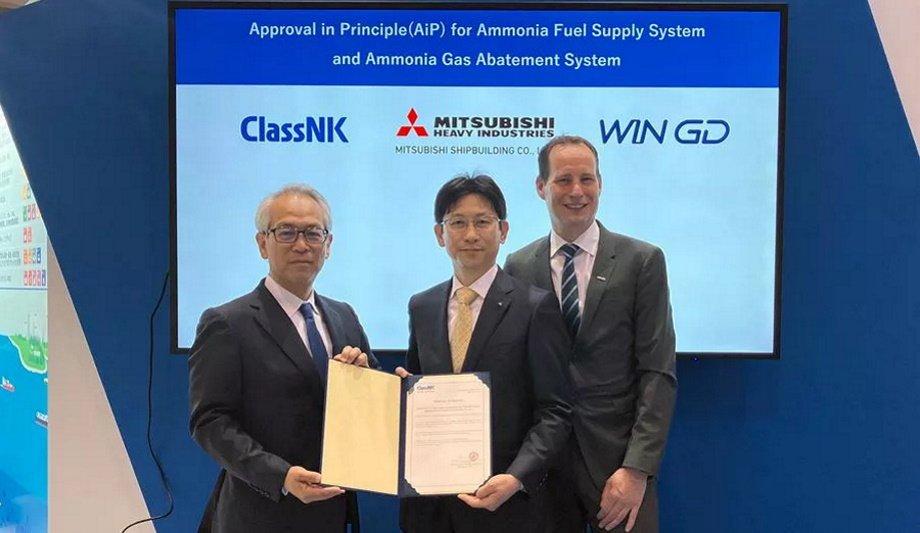

Mitsubishi Shipbuilding Co, Ltd., a part of Mitsubishi Heavy Industries (MHI) Group, has acquired Approval in Principle (AiP) from the Japanese classification society - ClassNK for an ammonia fuel supply system (AFSS) for the ‘X-DF-A’, a large, low-speed 2-stroke ammonia-fuelled engine under development by WinGD, a Swiss designer and licensor of large marine engines.
The AiP presentation ceremony took place at ‘Sea Japan 2024’ international maritime exhibition and conference at Tokyo Big Sight, in Tokyo, Japan.
Mitsubishi Shipbuilding and WinGD concluded a MOU
The AiP was acquired together with approval of a new ammonia gas abatement system (AGAS)
In June 2023, Mitsubishi Shipbuilding and WinGD concluded a memorandum of understanding (MOU) to undertake joint technical studies on an AFSS, aiming to contribute to the achievement of a new target set by the International Maritime Organization (IMO) of net zero greenhouse gas (GHG) emissions in the global maritime industry by or around 2050.
The joint studies resulted in finalisation in February 2024 of the basic design for an AFSS for the ‘X-DF-A’ engine under development by WinGD. The AiP was acquired together with approval of a new ammonia gas abatement system (AGAS), and now technical studies will go forward with WinGD toward commercialisation.
Ammonia as an alternate fuel
Because ammonia emits no CO2 when combusted, it is attracting attention today as a fuel with the potential to contribute significantly to reducing GHG emissions in the maritime industry, and it is expected to be utilised in the future as a source of stable, clean energy.
Going forward, Mitsubishi Shipbuilding will continue to develop marine ammonia handling systems, including fuel supply systems for ammonia combustion systems for the X-DF-A and other engines, as well as various ammonia gas abatement system systems.
Promote decarbonisation of the maritime industry
In addition, by proposing the design and engineering of ammonia-fuelled ships and onboard plants - comprising multiple ammonia-fuelled combustion systems, such as main engines, power generation engines, and boilers - Mitsubishi Shipbuilding will promote decarbonisation of the maritime industry towards realising a carbon-neutral society, and also contribute to reduction of environmental impacts on a global scale.