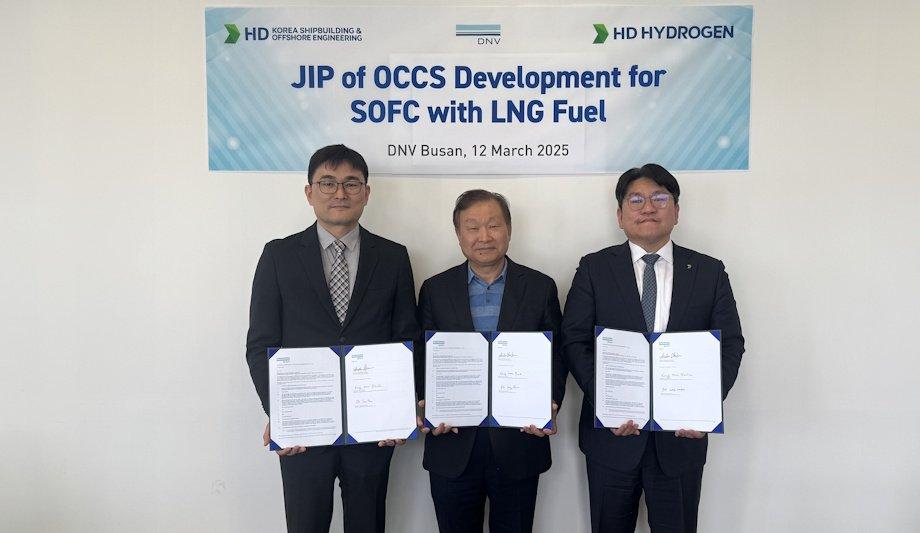

HD Korea Shipbuilding and Offshore Engineering (HD KSOE), HD Hydrogen, and DNV recently signed a Joint Industry Project (JIP) agreement to develop and validate Pressure Swing Adsorption (PSA) technology for carbon capture in Solid Oxide Fuel Cells (SOFC).
SOFCs are high-efficiency fuel cells that generate electricity using natural gas, ammonia, or hydrogen as fuel.
Maritime carbon emissions
As part of this agreement, HD KSOE and its subsidiary HD Hydrogen will explore the integration of PSA-based carbon capture technology into SOFCs for shipboard power generation.
The ultimate goal is to replace conventional ship propulsion and power generation engines with SOFC systems, significantly reducing maritime carbon emissions.
Power generation systems
HD Hydrogen will explore the integration of PSA-based carbon capture technology into SOFCs
Seunghwan Oh, Vice President of Business Development and Strategy at HD Hydrogen, said: "PSA technology is a key enabler in the era of Carbon Capture, Utilisation, and Storage (CCUS)."
"Integrating this technology with SOFCs, one of the most efficient power generation systems available, can substantially contribute to maritime decarbonization."
Decarbonisation of shipping
Vidar Dolonen, Regional Manager for DNV Korea & Japan, emphasised the importance of prioritizing technological solutions for emissions reductions: "The decarbonisation of shipping is a complex challenge, requiring a mix of solutions to bridge the transition to carbon-neutral fuels."
"Energy efficiency measures and onboard carbon capture technologies can play a crucial role in reducing emissions while the industry works towards securing reliable supplies of alternative fuels. This collaboration represents an important step in exploring practical and scalable carbon reduction strategies for the maritime sector."
CO2 absorption technologies
PSA technology selectively captures and releases CO2 by cyclically altering pressure within a capture chamber.
This approach is expected to be at least 40% more energy-efficient than conventional CO2 absorption technologies used in marine applications.